Showing posts with label worldwide catastrophes. Show all posts

Thursday, February 9, 2023

Change of plans

Lake Whatcom 

 Melanie and I had tentatively decided to hike to Lizard Lake on Blanchard Mountain today, but we woke to a light rain, expected to continue on and off all morning. So, we changed our plans and instead headed to the Hertz trail, and we went out and back for 6.2 miles, mostly flat. I'm glad we did, because the rain didn't quit until close to the end of our excursion. Not that I mind a bit of rain, but it would have been quite muddy as well. Two things I can do without.

Bench where you can rest a bit

We didn't have much to photograph, nothing new at any rate, but I remember passing by this bench many times over the years. It was wet and uninviting today. It was much nicer just to keep moving to stay warm and enjoy each other's company.

Fog, fir trees, and calm waters

We never had even a glimpse of sun, or even a shadow, but towards the end of our walk, we did see the clouds lighten a little, and I always enjoy seeing the trees looking so beautiful through the low-lying fog. It was, as always, nice to be outdoors and getting in our daily exercise. Mel's car has heated seats, so it wasn't easy to pry myself out for our Thursday hike, but I'm glad I did. We are in much better moods than before we started. Hopefully, next week we can do Blanchard Mountain.

I am struggling to maintain my positivity when I read the news. As of today, the death toll from the earthquake in Turkey/Syria has surpassed 20,000. It's an unbelievable tragedy. If you are looking for a good place to donate money, I recommend Doctors Without Borders, which performs incredible assistance all over the world. They have been helping with this awful disaster since right after it struck three days ago. It's my favorite go-to humanitarian assistance website. 

And prayers can only help. Stay positive, my friends.

:-}

Tuesday, February 7, 2023

Tuesday's musings

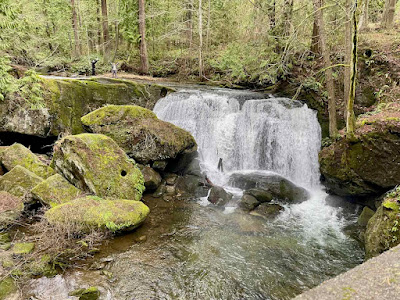
Whatcom Falls last Saturday

After a pretty miserable wet morning, with lots of time spent going from place to place on the bus, I was happy to get home, with a chance to dry off and settle in for the rest of the day. One of the things I did today, for the first time, was to attend a Zumba class at the Senior Center. This was billed as "Zumba Gold," which is especially tailored for seniors. It's a very popular class, and one of my good friends attends regularly.

There were at least twenty women in the class, and the instructor was quite good. She also teaches a regular Zumba class, and this was hard enough that I wondered what is different about the traditional class. It was fun, and I got a good workout, so you know I'll be going back to attend again. They also offer a yoga class twice a week so I signed up for one next Monday and will see how that goes. Little by little, I'm getting my exercise routine back on track. But I still want to join a regular yoga studio and will make my way there eventually.

After such an awful start to the day, I was completely taken by surprise when it not only stopped raining, but the sun is shining gloriously. It seems like it's been quite awhile since I've seen so much sunshine. The days are beginning to lengthen, and we have passed the halfway point between winter and spring on the calendar. I see fat buds on the trees, too.

I am staying away from the news, since that terrible earthquake in Turkey and Syria is taking up all the oxygen, and I can barely stand to see it happening. Often when I think my world is dire, all I have to do is think about the people suffering in such conditions. My heart goes out to them. 

:-(

Tuesday, November 15, 2022

Day of 8 Billion

Snapped on my way home this morning

It was really cold this morning as I walked through Cornwall Park on my way home from the coffee shop. Or, at least from where John left me on the sidewalk to begin my two-and-a-half mile excursion. It got really cold last night, and we had a hard freeze, with these frozen leaves telling the tale. Although the brilliant sun was warming things up quickly, the places where it hadn't yet reached were quite beautiful in frosty splendor.
Frost is the most sophisticated of poets. —Peter Davison

 When I got home and warmed myself by the heater, I made a quick check of the news on my laptop. Two things struck me, the first was learning that today is the Day of 8 Billion. Yes, that's right: today is the estimated day that the human population reached that stupendous milestone. It only took us 12 years to increase from 7 billion to 8 billion. And during the past fifty years, two-thirds of the world's population of mammals (other than humans), fish, reptiles and amphibians have been lost. Two-thirds, I guess to make room for humanity. That's pretty terrifying, if you ask me.

The other unfortunate news is that moments after Ukraine President Zelensky spoke to the gathering of the Heads of States and Government in Indonesia, Russia launched a huge barrage of missiles at numerous targets in Ukraine, and one missile apparently landed in Poland, killing two people. Poland is a NATO member, and right now it's being assessed whether this was deliberate or not. If it is, there will be a huge escalation of the war in Ukraine, as the NATO members would need to come to Poland's aid. But I cannot believe it was deliberate, since Russia already has its hands full with a war they appear to be losing. Anyway, it just happened and more will be known in the fullness of time.

In any event, I will be trying my best to keep calm and remain optimistic. I am very grateful for my newfound meditation practice, since it seems to be helping me take world events in stride. At least a little bit. How about you? Have you found a way to maintain your equilibrium as the world shudders?

:-}

Monday, May 18, 2020

Forty years ago today

Mt St Helens blowing its top
I didn't live in Washington State when Mt St Helens erupted, forty years ago today. I was at work at the National Center for Atmospheric Research in Boulder, Colorado, with no thought that I might move to the Pacific Northwest in my future. That was a long time ago, and even thinking about retirement wasn't in my mind. I hadn't even started skydiving (that happened in 1990, ten years later.) But I sure remember the event.

We didn't have instantaneous news at that time, before cell phones became smart. We did have little wireless phones back then, but we used them for (gasp!) telephone calls. Somehow, though, the word got around the office about the eruption, and at home that evening we all learned that it was not only a major eruption, but due to the largest landslide in recorded history, the mountain lost 1,300 feet of its elevation.
Within three minutes of the volcanic eruption, the lateral blast, which traveled at more than 300 miles per hour, scorched 230 square miles of forest. More than 900,000 tons of ash was cleaned up from areas around Washington. (CNN)
Today in a Zoom class sponsored by the Y, the instructors asked everyone where they were that day. Of course, if you were younger than forty, you could not answer the question, but since this was a senior class, it was fascinating to hear what people who lived around here remember from that time. I was one of the few non-natives, it turns out.

Yesterday I stayed up longer than usual to finish the latest book on my Kindle, Spillover: Animal Infections and the Next Human Pandemic. I learned a ton from the book and went to the author's website (David Quammen) and found that he has written fifteen books so far and is still going strong. He discusses various diseases throughout time that have jumped from animal hosts into humans (called zoonosis). Although this one is scary, I was truly frightened to learn about some other viruses that didn't become pandemics, thank heavens, because they were way more lethal than this one. Quammen offers a few nuggets to help us understand how today's coronavirus pandemic came about (Orion Magazine).

  1. Prepare for the worst, while hoping for the best.
  2. Zoonotic spillovers will keep coming, as long as we drag wild animals to us and split them open.
  3. A tropical forest, with its vast diversity of visible creatures and microbes, is like a beautiful old barn: knock it over with a bulldozer and viruses will rise in the air like dust.
  4. Leave bats, in particular, the hell alone. 
On that cheery note, I have to say I was truly fascinated by the book and what I learned from it. I will continue to wash my hands and follow social distancing guidelines and wear a mask for the foreseeable future. I hope you will, too.
:-}

Thursday, April 23, 2020

Making my way through

Staying safe in the garden
No hike in the mountains today. Our Monday excursion will have to count for this week, although I did take a nice walk around the neighborhood in order to get enough steps to assuage my guilt. This morning was raining, so I let that be an excuse not to go somewhere to commune with the trees.

Someone posted this funny picture of the flamingos, even if they are not six feet apart, they are definitely not giving the coronavirus to one another. I would give credit to the photographer, if I knew who it was, but I don't. Now that we have been given the strong recommendation to wear face masks when out and about, almost everybody is doing just that, including the lawn ornaments. Today I ordered two face masks created by a skydiving friend who makes jumpsuits. He's not getting orders for any (since the sport is on hiatus like the rest of the world), so he's offering something that most of us can use during the pandemic.

I'm really wishing things would change sooner rather than later, but I suspect that it will be quite awhile before we stop dealing with this virus. It's getting a little scary out there, and I'm beginning to wonder how bad the economic hit will be for many of us, before things begin to open up again. I know that my monthly annuity check will be smaller, but how much smaller is not clear. I'll know in a week, and I've lost a good bit of sleep worrying, for all the good it does.

So many people have lost their jobs, 26 million in the US so far, and it's got to be just as bad in many other parts of the world. I see that a few countries are beginning to lessen their lockdowns, but it will take a good long time before any place will make any financial gain. Sometimes I allow myself to look at the situation clear-eyed without flinching, and I try to stay positive and look for the affirmative, heartening signs that we are through the worst of it.

The best part of my own situation is having my life partner going through it with me, and friends and family who keep checking on how I am. Of course, it's partly because they feel a need to keep an eye on the elders, of which I am definitely one. It's hard to fathom how much everything has changed in less than two months. How are you holding up?
:-}

Tuesday, April 10, 2018

Celestial painting

Astronomy Picture of the Day 4/7/2018
I was simply captivated by this Astronomy Picture of the Day on Saturday. I've always loved the way Jupiter's massive storms look in pictures, but this one is a closeup of Jupiter taken last December by the spacecraft orbiting the planet. It's been doctored a little:
The creative image uses actual data from the Juno spacecraft's JunoCam. To paint on the digital canvas, an image with light and dark tones was chosen for processing and an oil-painting software filter applied.
Isn't it beautiful? I look at APOD every day. It gives me a chance to gain a little perspective when things seem depressing and weird down here on Planet Earth. These days, I'm not sleeping all that well if I read the news before I go to bed. So, I'm trying to take a longer view of things, like gazing at our solar system's lovely Jovian giant.
:-}

Saturday, April 17, 2010

Icelandic volcano

Smoke & steam from volcano, 14 April. From the Examiner.
Wow. Most of us have seen these pictures, and more, about the Icelandic volcano under the Eyjafjallajokull glacier, disrupting air travel all over the world. It is shooting out smoke and steam as high as 55,000 feet. As most of us air travelers know, we usually fly around 30,000 feet in transatlantic flights. London Heathrow and most other European airports are closed. Planes cannot fly safely through the ash, because it gets into the engines and makes them freeze up. Not a good thing for anybody. Flights are being allowed at lower VFR (visual flight rules) altitudes, but the whole mess is complicated by the fact that the volcano shows no signs of letting up. Not to mention that the high pressure over most of Europe is keeping the ash from dispersing.

This is not the first time that an Icelandic volcano has caused such disruptions. I found that the Laki eruption in 1783 is thought to have had worldwide ramifications for years. It continued to erupt for eight months. There is a great Wikipedia link about this one, and I found this to be very frightening:
The consequences for Iceland—known as the Mist Hardships—were catastrophic. An estimated 20-25% of the population died in the famine and fluorine poisoning after the fissure eruptions ceased. Around 80% of sheep, 50% of cattle and 50% of horses died because of dental and skeletal fluorisis from the 8 million tons of hydrogen fluoride that were released.
That was in Iceland. In Europe, tens of thousands of people died because of the massive amounts of ash and sulfur dioxide that traveled across the water to Europe. The link gives some fascinating information (not at all reassuring), and blames the Laki eruption for the French Revolution!

We can only hope that worldwide travel disruptions will be the only thing that we humans and other animals experience from this one. It makes me remember how little we can protect ourselves from catastrophic events, and how powerful they are. Does anybody else feel like these things (earthquakes, volcanic eruptions, etc.) are increasing?
:-(